Featured

What Councils Can Do to Tackle Poverty

By Julian McGrath

Finalist – NILGA 2025 Local Government Awards, Best Initiative by a Councillor

Northern Ireland’s local councils are demonstrating that even without sweeping legislative powers, they can lead the way in tackling poverty—through partnership, coordination, and strategic focus.

The need could not be clearer. Both the Northern Ireland Audit Office (NIAO) and the Public Accounts Committee (PAC) have issued damning reports on the Executive’s failure to reduce child poverty. They highlighted a lack of measurable targets, poor interdepartmental coordination, and no ring-fenced budget. The PAC described Stormont’s approach as a “catalogue of failures.” Despite these findings, no new anti-poverty strategy has been produced.

In this context, councils are stepping up—not because they are required to, but because they can, and because they should.

Local Action with Real Impact

In January 2024, Antrim and Newtownabbey Borough Council passed my motion to establish an Anti-Poverty Steering Group. The group brings together elected members from across political parties, senior officers, and community partners to develop and drive forward a borough-wide anti-poverty strategy.

The group’s work is focused on mapping existing services, identifying duplication, strengthening interdepartmental communication, and ensuring better alignment between the council and those delivering vital support on the ground.

Some excellent local services already exist—such as the borough-wide school uniform support scheme and the Christmas toy initiative—and will be incorporated into the strategy. These initiatives are just part of the broader network of support the council has helped build over recent years. The challenge now is to connect, coordinate and expand that work into a more strategic framework.

What Councils Can Do

While councils in Northern Ireland do not control education, housing, or welfare policy, they do hold important powers in economic development, community planning, sustainability, and local regeneration. These levers, when applied cohesively and strategically, can have a direct and lasting impact on the structural causes of poverty.

Key to this approach is recognising that every department has a role to play. In Antrim and Newtownabbey, for example, sustainability officers, economic development teams, and community planners are all contributing to the strategy—reflecting a growing understanding that poverty is not someone else’s problem. It is a shared civic challenge.

A Local Movement Across Northern Ireland

Councils across Northern Ireland are moving in the same direction. Fermanagh and Omagh District Council’s Pathways out of Poverty strategy, developed in partnership with health trusts, community organisations, and local people, shows what can be achieved through cross-sector collaboration.

There is growing recognition that poverty cannot be addressed in isolation. It cuts across housing, health, education, and the economy—and so must our responses. Councils, with their close ties to local communities and ability to convene partners, are uniquely placed to lead this work.

Leadership Where It’s Needed

The PAC and Audit Office reports are clear: the lack of leadership from Stormont has left significant gaps in policy and provision. But they also point to local councils as key agents of delivery.

Councils may not hold all the powers, but they hold knowledge, trust, and relationships. They can map services, bring agencies together, reduce duplication, and coordinate responses. That kind of leadership—grounded in place and shaped by need—is not just useful. It is essential.

What is needed now is formal recognition of local government’s role. Councils should not be seen as emergency backstops but as full partners in designing and delivering anti-poverty solutions.

Across Northern Ireland, councils are showing what’s possible. With strategic focus, collaboration, and a commitment to act, local government is not simply managing poverty—it is working to reduce it.

Featured

Will our children be going to war?

If recent discussions about the possibility of a third world war and the reintroduction of conscription in GB – with potential attempts to include Northern Ireland – has made you feel very uneasy, read on…

Such distressing messages have surged across news outlets and social media, with some MPs urging conscription now. While many of us may fall outside the typical age range for military service, the very real prospect raises genuine concerns for those with children or grandchildren who could be affected. The question of whether conscription could return—and under what circumstances—requires an understanding of its history, the exemptions that existed, Northern Ireland’s unique position, and Ireland’s steadfast neutrality.

It is a sobering thought that if you were Ukranian or Russian right now, this would already be your reality. It is also sobering to think that other European nations would possibly have to match this level of involvement in the event of a war with a Russian aggressor. Russia has called up 300,000+ troops with many young men fleeing the country to avoid mobilisation. In 2024 it introduced a new electronic draft system which prevents men leaving the country once summoned.

Ukraine’s response to the Russian invasion was to introduce Martial Law and general mobilisation. All men, aged 18-60, were banned from leaving the country and by 2023 its military had reportedly 700,000 men. This is not make-believe, but a very harsh reality for the people of both countries. To be complacent about this would be foolish, but exactly how worried should we be? I try to assess this fairly in this post.

The History of Conscription in the UK

During the First World War, the United Kingdom introduced conscription through the Military Service Act of 1916. Initially, this applied to single men aged between 18 and 41, though exemptions were granted for those who were medically unfit, clergymen, teachers, and certain industrial workers. The conscription age was later extended to 51, and although Britain faced significant manpower shortages, conscription was never enforced in Ireland. Widespread opposition made its implementation politically untenable, and resistance to the measure further fuelled Irish nationalist sentiment, contributing to the movement for independence.

However, certain workers in key industries were exempt from the draft because their labour was essential to the war effort. These “reserved occupations” included munitions workers, who produced the weapons and ammunition needed for combat, as well as coal miners, whose work fuelled warships, trains, and factories. Shipbuilders and dock workers were also protected, as the Royal Navy relied on a constant supply of new vessels. Similarly, railway and transport workers were crucial for moving troops and supplies, while farmers and agricultural workers ensured food production remained stable, especially as German U-boats disrupted imports.

By the late 1930s, tensions in Europe had once again made military preparedness a priority. In May 1939, the UK introduced the Military Training Act, marking its first peacetime conscription law. This initially required single men aged 20 and 21 to complete six months of military training but following the outbreak of the Second World War in September 1939, the National Service (Armed Forces) Act extended this to all men aged 18 to 41.

However, once again exemptions were granted to those in reserved occupations, whose work was deemed essential to the war effort. This included munitions workers, who produced weapons and ammunition, as well as coal miners, steel and ironworkers, and shipbuilders, all of whom played a critical role in maintaining Britain’s military strength. Railway workers, lorry drivers, and dock labourers were also exempt as they were vital for transporting troops, supplies, and equipment. Similarly, farmers, agricultural workers, and anglers were protected from conscription to ensure the nation’s food security, especially as German U-boats again threatened imports.

In WW2 exemptions were also granted on medical and moral grounds. Those deemed physically or mentally unfit were excused from service, while conscientious objectors, who opposed military service for religious or ethical reasons, could appeal to tribunals. If approved, they were often assigned to non-combat roles such as medical services, civil defence, or bomb disposal. Despite these exemptions, many reserved workers were required to remain in their industries under strict wartime regulations, ensuring that Britain could sustain both its military and civilian needs throughout the conflict.

In contrast to the rest of the UK, Northern Ireland was excluded from this mandate.

Why Was Northern Ireland Exempt?

Conscription in Northern Ireland was a politically delicate issue. The UK government recognised that enforcing compulsory service in the region could provoke significant backlash, particularly among the nationalist population. During both world wars, efforts to introduce conscription faced strong resistance, not just from nationalists but also from sections of the unionist community, who feared it could destabilise the region. Instead, Northern Ireland relied on voluntary recruitment, and thousands still joined the British armed forces.

This exemption continued into the post-war period, meaning that when the UK introduced National Service in 1947—a policy requiring all young men to serve in the military for up to two years—Northern Ireland was once again excluded. By contrast, National Service remained a legal obligation in Great Britain until its abolition in 1960.

What about those with Irish passports?

Ireland formally adopted a policy of neutrality during the Second World War. The Irish government under Éamon de Valera remained committed to non-alignment, even refusing to allow British forces to use Irish ports. This stance, while controversial at the time, has shaped Ireland’s approach to international conflicts ever since.

Today, Ireland continues to uphold its policy of military neutrality. While it participates in international peacekeeping missions, particularly under the United Nations, it remains outside formal military alliances such as NATO. This position is protected under the Irish Constitution and reinforced through various EU treaties, including the Lisbon Treaty, which recognises Ireland’s right to remain neutral. Given this long-standing policy, the likelihood of Ireland introducing conscription or being drawn into a global conflict in the same manner as NATO countries is low.

In any event, what is the actual likelihood of World War Three?

The Shadow of 1938: Parallels and Differences

The recent surge in discussions about conscription and global conflict is driven by Russia’s ongoing war in Ukraine. Some historians and analysts have drawn parallels between today’s situation and the late 1930s, when British Prime Minister Neville Chamberlain pursued a policy of appeasement towards Nazi Germany. In 1938, Chamberlain allowed Adolf Hitler to annex the Sudetenland, part of Czechoslovakia, without military intervention—a move now widely seen as emboldening Germany and setting the stage for the Second World War.

As of March 2025, tensions between Donald Trump and Vladimir Putin remain a focal point of global diplomacy. Trump held a high-profile call with Putin to discuss a possible ceasefire, with reports suggesting that negotiations centre around what Ukraine may have to concede for peace. Putin has rejected the ceasefire and NATO allies are watching closely, as Trump’s approach has raised concerns about whether he might end up pushing for a deal that favours Russia more extensively. The broader geopolitical implications of these discussions remain uncertain, as Trump’s relationship with Putin continues to be scrutinised by both U.S. lawmakers and international leaders.

The situation in March 2025 bears some striking similarities to the Munich Agreement of 1938. In 1938, Britain and France, under Neville Chamberlain’s appeasement policy, allowed Hitler to annex the Sudetenland from Czechoslovakia in the hope of preventing a larger war—only for Germany to invade the rest of Czechoslovakia months later, proving appeasement a failure. Today, Donald Trump’s negotiations with Vladimir Putin over a possible Ukraine ceasefire raise concerns that he may pressure Ukraine into territorial concessions, mirroring the logic behind Munich. If Ukraine is forced to cede land—such as Donbas or Crimea—in exchange for “peace,” it could embolden Putin to continue expanding his influence, just as Hitler did after Munich. 

There are crucial differences to 1938, however. One of the most critical differences between 1938 and 2025 is the existence of NATO. NATOserves as a powerful military deterrent against Russian expansion. In 1938, the League of Nations was a weak, ineffective organisation with no real ability to prevent Hitler’s aggression, whereas NATO is the world’s most powerful military alliance. And even if it is not fully backed by a Trump administration, there is still Britain, France, Germany, and over 30 other nations. The core principle of Article 5—which states that an attack on one member is an attack on all—creates a major risk for Putin if he attempts to invade NATO territory, unlike Hitler, who faced no immediate military consequences for annexing Austria and Czechoslovakia. Additionally, NATO’s rapid deployment forces, nuclear capabilities, and advanced intelligence networks ensure that any Russian aggression beyond Ukraine would be met with overwhelming military resistance. Unlike in 1938, when Hitler could expand unchecked, Russia’s ambitions are constrained by the threat of direct NATO retaliation, forcing Putin to rely on hybrid warfare, cyber-attacks, and proxy conflicts instead of outright invasions.

Secondly, unlike Czechoslovakia in 1938, which was forced to surrender without a fight, Ukraine in 2025 is a battle-hardened nation with over three years of experience resisting a full-scale Russian invasion. Ukrainian forces have gained urban combat expertise, mastered trench warfare, and effectively integrated Western military technology, including a High Mobility Artillery Rocket System (HIMARS), long-range missiles, and air defence systems. Unlike in 1938, when Britain and France failed to act decisively, Ukraine has received extensive NATO training and equipment, allowing it to maintain strong defensive positions. The psychological and tactical resilience of Ukraine’s military also sets it apart—Kyiv has no illusions about Moscow’s intentions and is prepared to resist, even if external support wavers. While Czechoslovakia was diplomatically isolated in 1938, Ukraine has a unified Western bloc backing its war effort, despiteTrump’s stance on continued U.S. military aid.

Thirdly, another key difference between 1939 and today is the presence of nuclear weapons, which serves as a deterrent against full-scale global war. In 1939, Germany faced no immediate consequences for its invasions, as Britain and France hesitated to act. In 2025, Russia and NATO both possess thousands of nuclear warheads, making direct military conflict a catastrophic risk for all sides. The doctrine of Mutually Assured Destruction (MAD) ensures that neither Russia nor NATO can escalate beyond a certain threshold without risking total annihilation. Even though Putin has repeatedly issued nuclear threats, he has refrained from using tactical nukes in Ukraine, indicating that deterrence is still effective. This nuclear reality significantly alters global decision-making compared to 1939 when large-scale land invasions were the primary method of military expansion.

Fourthly, the modern global economy is far more interconnected than it was in 1939, making large-scale war far less viable. In the 1930s, Germany and Japan pursued autarkic economic models, meaning war was necessary for resource acquisition. Today, Russia depends on China, India, and Middle Eastern allies to sustain its war economy, while the West relies on economic sanctions rather than direct military intervention to weaken Moscow. Furthermore, China, which plays a stabilising role in today’s economy, has shown reluctance to fully back Russia, as a prolonged war would hurt its global economic interests.

Finally, in 1938 Hitler’s strategy depended upon Blitzkrieg (“lightning war”), which relied on rapid, coordinated attacks using tanks, mechanised infantry, and air power. This, according to experts, would be far less effective in modern warfare due to advances in defensive technology, intelligence, and battlefield awareness. In World War II, nations had limited early warning systems, allowing German forces to quickly break through enemy lines before defences could be organised. Today, however, real-time satellite surveillance, drones, and advanced radar systems would detect large troop movements long before an attack begins, preventing surprise offensives. Additionally, modern air defences, precision-guided artillery (such as HIMARS), and anti-tank weapons would make it extremely difficult for a large, mechanised force to advance significantly behind enemy lines without suffering heavy losses. The presence of nuclear weapons and cyber warfare also fundamentally changes the dynamics, as full-scale invasions risk rapid escalation beyond conventional military means. While Blitzkrieg was highly effective in pre-nuclear, pre-digital warfare, experts suggest it would struggle against modern technology, long-range precision strikes, and superior battlefield intelligence systems.

So, in short, while there are similarities to 1938, such as Western indecision and an expansionist Russia; Ukraine’s military resilience, nuclear deterrence, and economic interdependence create a fundamentally different landscape from the one that led to World War II.

However, this still does not answer the question: Are We on the Brink of World War 3?

Even though it is different to 1938, no one can know what is in store.

Only a week before WW2 estimates suggest 60% of the UK population expected war, but very few, if anyone, expected a full-scale global conflict – even soon after the war had already started! Most people believed this war would be a regional conflict between Germany and Poland in Eastern Europe. How things can develop is a very scary lesson from history.

History also offers warnings about the dangers of appeasement, but as previously discussed, there are also significant differences between 1938 and the present day. Economically, Russia is also in a different position than Nazi Germany. Hitler’s war machine relied on rapid territorial expansion to sustain itself, whereas Russia’s economy is strained by sanctions and remains dependent on global trade, particularly through its ties to China. I say this with some caution – as in many ways Russia is stronger today than Germany was in 1939 – but economic and strategic constraints mean that while Russia may continue its war in Ukraine, its ability to launch a broader conflict remains limited.

What Comes Next?

For those concerned about the possibility of conscription returning, historical precedent suggests that such measures would only be introduced in extreme circumstances. Modern warfare relies less on large numbers of infantry and more on advanced technology, drones, and cyber capabilities. Any reintroduction of conscription in the UK would require not just a major conflict but also extensive political debate and public consultation. Furthermore, even in Putin’s Russia today, conscripts are technically not supposed to be sent to the frontline (although this reportedly happens). For us, crucially, given Northern Ireland’s historical exemptions, it is also probable that it would once again be excluded by Westminster.

The Republic of Ireland remains committed to neutrality, making it highly unlikely that conscription would be introduced there. However, the broader questions about global security remain. If Western commitments to Ukraine weaken, or if NATO divisions emerge, Russia may see an opportunity to escalate its ambitions. The risk may be a third world war, but this is not necessarily the case. Either way, we are bracing for a prolonged period of instability and conflict at the very least, sadly.

While history does not repeat itself in an exact format, it does nevertheless repeat itself in that human beings continue, time and again, to fight over contested resources leading to mass suffering. Today’s world is shaped by different forces than the 1930s —technology, nuclear deterrence, and economic interdependence—but the dangers of miscalculation and unchecked aggression remain as relevant as ever. Whether today’s leaders have learned from the mistakes of the past will ultimately determine whether we stumble into a new, deadly, global conflict.


Featured

Why is Russia invading Ukraine?

Was going to post this weekend about the salient issues around Russia v Ukraine, but a colleague saved me and sent me this video. I think it says much of it, much better, than I ever could.

It doesn’t deal too much with either historical or current international relations or internal Russian politics; nor does it address the complex internal Ukraine politics. It does however address the historical & modern economic considerations brilliantly. And these are probably the primary concerns right throughout history, anyway.

So although the coverage is limited in some ways, one thing a degree in both history and politics has taught me is that you have to cut your cloth.

This is very well worth a watch for anyone trying to understand what is certainly potentially the most significant crisis in my lifetime.

👉 https://youtu.be/If61baWF4GE

👉 https://youtu.be/If61baWF4GE

Public Says Enough: Time for an Effective Anti-Poverty Strategy in Northern Ireland

A new poll published this week by LucidTalk on behalf of Save the Children NI has laid bare public frustration with the failure to address child poverty in Northern Ireland. The results are stark:

80% believe child poverty has worsened in recent years, mainly due to the rising cost of living. 67% support universal access to affordable childcare. 66% back more social housing provision. 64% want increased funding for schools in deprived areas. 60% support universal free school meals. And yet, just 5% of respondents believe that politicians are currently taking meaningful action to tackle child poverty.

This overwhelming consensus sends a powerful message: people in Northern Ireland want a proper, resourced anti-poverty strategy—and they want it now.

A Strategy Long Promised, Still Missing

Under Section 28E of the Northern Ireland Act 1998, the Executive is legally required to adopt a strategy for tackling poverty, social exclusion and patterns of deprivation based on objective need. Yet, twenty-five years later, and one year on from the restoration of devolved government, no such strategy has been published.

In its submission to the Assembly a year ago, Save the Children highlighted this legal failure and made the case for a child-focused, measurable strategy. The paper also underscored the damaging lack of cross-departmental co-ordination and meaningful engagement with those experiencing poverty. “Past strategies,” it warned, “have failed due to weak accountability, vague ambitions, and the absence of lived experience in shaping policy.”

These points echo concerns raised in recent years by both the Northern Ireland Audit Office and the Public Accounts Committee, which have criticised disjointed anti-poverty efforts, poor delivery planning, and the absence of clear mechanisms to measure progress.

Local Government Has Stepped Up

While Stormont deliberates, local councils are already taking action. One example is my own council, Antrim and Newtownabbey Borough Council. A year ago we launched a cross-party Anti-Poverty Steering Group and published a framework strategy document.

Rather than waiting passively, the Council has begun mapping all existing services to identify gaps, duplication and inefficiencies; it is focusing on strengthening collaboration across council departments, from Community Planning to Economic Development & setting up closer working relations with stakeholders already delivering frontline support.

Longstanding initiatives such as the school uniform support scheme and the borough-wide Christmas toy donations—alongside food, fuel, and family support services—are now being drawn together under a shared strategy. The Council’s Anti-Poverty Strategy booklet sets out a commitment to practical action, clear principles, and ongoing community engagement.

Turning Pressure Into Policy

Separately (for now), in February, nearly twenty organisations launched an Anti-Poverty Strategy Group at Stormont to press for a credible and timely Executive-led strategy. Their Core Principles include time-bound targets, full resourcing, a lifecycle approach, and—critically—participation by civil society and most crucially those with lived experience.

The newly re-established Executive has now confirmed that a strategy is in development. But public confidence is low. The longer the delay, the greater the risk of compounding cynicism and leaving real needs unmet.

As Peter Bryson of Save the Children NI put it:

“People want an ambitious plan that sets out concrete targets, realistic objectives, and tangible steps to bring about transformation for the one in four children here who live daily with the limiting realities of poverty.”

Those words should not only guide Stormont’s next steps—they should define them.

A Strategy Long Overdue – Now Delivery Must Match the Promise

Today’s announcement that the Northern Ireland Executive has agreed a draft Anti-Poverty Strategy is a long-overdue but important milestone. For nearly two decades, there has been a legal obligation under the Northern Ireland Act (as amended by the St Andrews Agreement) to bring forward a strategy to address poverty, social exclusion, and patterns of deprivation based on objective need.

This duty remained unfulfilled for years. Child poverty in Northern Ireland has persisted stubbornly, with nearly one in five children living in relative poverty. Both the Northern Ireland Audit Office and the Public Accounts Committee have sharply criticised previous efforts, highlighting a lack of measurable targets, poor coordination across departments, insufficient community involvement, and a failure to direct resources effectively.

Those failings have left local government, the voluntary sector, and frontline organisations to fill the void as best they can. The publication of a regional strategy is therefore welcome—but its value will depend entirely on how it is implemented.

Cross-Party Action in Antrim and Newtownabbey

While waiting for the regional strategy to emerge, Antrim and Newtownabbey Borough Council has taken decisive local action and should be in good shape to collaborate meaningfully with the Stormont department.

Earlier this year, councillors from across the political spectrum supported the creation of a cross-party Anti-Poverty Steering Group, which is now actively overseeing the development and delivery of the council’s own Anti-Poverty Strategy.

This local strategy is a live, working document—designed to evolve in response to community needs and evidence on the ground.

The council is undertaking a detailed mapping of anti-poverty interventions across the borough.

This includes identifying:

Where services are currently effective?

Where there is duplication or overlap?

Where provision is missing altogether?

This mapping work is essential to avoid siloed working, ensure better resource use, and create a shared understanding of support across agencies.

Improving Coordination and Communication

A key focus is strengthening how different departments—such as community planning, sustainability, and economic development—work together internally, and how council connects with community-based support. Clear referral pathways, joined-up working, and active signposting are being prioritised.

Sustaining What Already Works

Practical initiatives such as the borough-wide school uniform support scheme, the Christmas toy initiative, and local food redistribution partnerships are already making an impact and are now being embedded within the broader strategy to ensure they are supported and developed further.

What Must Happen Next

The Stormont strategy must now move swiftly from paper to delivery. If it is to succeed where previous efforts have failed, it must include:

Measurable targets

Clear funding commitments

Mechanisms for accountability

A central role for local councils and communities in delivery

Local government may not hold the levers for welfare, education, or housing—but it is embedded in the everyday realities of people’s lives. Councils can convene, coordinate, and collaborate. When given the mandate and the resources, they can lead.

Undoubtedly stakeholders across Antrim and Newtownabbey will now study the Executive’s proposals in detail and respond constructively to the consultation. The council’s own strategy will continue to move forward—driven by shared purpose, cross-party consensus, and the contributions of those working every day to support residents in need.

Our education mess

Too many people, across the UK, with the aim of doing good but with zero experience working in education clambered for GCSE, AS-Level & A-Level examinations to be scrapped from an early stage.

Now they are scrapped.

Guess what all the teenagers in these age groups are going back to school to do in 12 days time… exams. Much earlier examinations than what they would have been = much less time to prepare – for them and teachers, on the back of a lengthy lockdown.

Everyone wanted a “fair” system. Well, we moved from anonymous students being assessed by anonymous examiners to pupils being assessed by their teacher … very publicly. No anonymity for either… with university places hanging in the balance.

We moved from a detached examination body setting, assessing & moderating students to imposing the setting, assessing and moderating of student work on to the classroom teacher, whilst they are still trying to teach, assess and provide feedback to all of the other students in the school.

I do understand that many people only moved to the position whereby exams should be scrapped later, when they felt there was no other option. I also fully appreciate that, when the remainder of the UK made these decisions to scrap exams , NI was placed in a position where parity was needed. I myself accepted at this point that we were in a hole and exams had to go.

So, now we can all share parity in a total and utter mess.

However, there WERE options a year ago, even 8 months ago.

I stress, the current mess is NOT down to COVID. It is down to very poor decision-making and an unwillingness to listen to school principals & educationalists, a year ago, when each subject had a full summer (and more) to put workable alternatives in place. Many alternatives were proposed by teachers on the ground themselves, and completely ignored.

Courses could and should have been squashed in May/June/July/August 2020 (which is what is happening haphazardly now). Assessments could and should have been made then for the newly squashed versions of the curriculum – maintaining the integrity of all the subject Assessment Objectives.

A number of educationalists suggested squashing examination courses by as much as 60% as far back as June 2020. A winter wave of Covid was expected. Everyone was told this. It wasn’t a secret.

At Christmas, when the predicted second wave had struck, the decision was then taken to do just this. Scrap huge chunks of the course.

It was disastrously late.

Teachers, given no proper direction, had taught different aspects in different schools.

On Friday 5th March 2021, guidance about exams and processes was released. Not until Friday 19th March 2021, however, will teachers be provided specific subject guidance. I am told that some students, maybe your child, in some schools, are being assessed in the week beginning Monday 22nd March.

*This is NOT a criticism of any school. Schools are now working to very tight timetables to submit marks and gather substantial evidence and complete administration in time for a May deadline. Many of these schools will not have been able to have their Winter exams if they were in January.

I know these “final” assessments are not the fullness of what can contribute toward the grade. This is actually a relatively significant difference to running external examinations, but for 16-18 year olds, when they know something contributes to that grade, tensions are heightened just the same. There was also an option a year ago for a hybrid of external (exam board) / internal (school) assessment, where this didn’t already exist.

Let me put these dates in context. GCSE, AS & ALEVEL teachers “map” their curriculum for each year. My target every year is to have the course taught as close to St Patrick’s Day as possible (I rarely manage this, but it is a target), to allow for examination technique, practice assessments, feedback, fine tuning etc- because, before you know it it’s Easter and the students will all but have started many formal assessments, which will take them through April (some practical/listenings etc), May & June.

So I’ll repeat that: teachers are receiving subject specific guidance on 19th March, after only finding out the processes for assessment on 5th March, for assessments to happen in the coming weeks…

I give up.

So long, farewell, au revoir, auf wiedersehen

We are saying “so long, farewell, auf Wiedersehen, adieu” to our European friends. Of course, it was at the start of 2020 that the UK actually left the European Union, but some four and a half long years since the shock outcome of the Referendum of 23rd June 2016, the ‘transition’ period is now over. There is a semblance of finality to what has been a tortuous Brexit process (and will likely continue to be). In the five and a half years since the referendum was announced I have been struck at how binary the argument became. We have become a polarised people – with either a staunch defence (even love) of, or staunch attacks on, the European Union. The truth is, as ever with such complex issues, a more nuanced assessment of the benefits of being in or out of the EU is more realistic.

I believe that the vote to leave the European Union was a misjudgement. Dozens of UK YouGov polls, conducted every single week since the referendum, indicate that more people in the UK consistently agree with this assessment than disagree. Stephen Farry MP expressed it aptly this week, when he said:

In this modern world, we are all interdependent. We can’t maximise prosperity, address climate change, fight pandemics, and project influence around the world in splendid isolation.”

I am going to go even further and assert that this ‘interdependence’, embodied by the European Union, has been the bed-rock of a largely stable and peaceful Europe. It has also played a huge role in bringing stability to Northern Ireland. We are in very real danger of taking this international and local stability for granted. History tells us this is a massive mis-calculation.

The story of Altiero Spinelli, one of the European Union’s founding fathers, encapsulates the importance of a ‘united European project’. Spinelli was imprisoned for ten years for opposing Mussolini’s fascist regime. In 1941, whilst in prison he and a fellow prisoner completed the Ventotene Manifesto. Entitled Per un’Europa Liberia e Unita (For a Free and United Europe), the manifesto argued that the war against the virulent nationalism of the fascist powers would be empty if it simply led to the re-establishment of the old European system of sovereign nation-states. Spinelli believed, should this happen, further war would be inevitable.

Jump forward to 2021 and I believe the basic premise is the same. The driving force for some Brexiteers to be such a ‘sovereign nation-state’ is, in my view, very short-sighted. If the UK exit from the EU were to precipitate a wider break-down of the institutions, this could lead to a substantial destabilisation of international relations in the longer term. It may sound far-fetched but history teaches us, time and again, just how rapidly relations can deteriorate.

The primary aim of the EU’s founding fathers was to connect European countries so closely and intimately that they would not be able to go to war with one another. EU founding father & French Foreign Minister, Robert Schuman, declared…

We are carrying out a great experiment, the fulfillment of the same recurrent dream that for ten centuries has revisited the peoples of Europe: creating between them an organization putting an end to war and guaranteeing an eternal peace.”

Robert Schuman, French Foreign Minister speaking in London in May 1949

The Schuman Declaration, a year later, which proposed the creation of a European Coal and Steel Community, reiterated how such a measure was primarily aimed at securing peace in Europe.

World peace cannot be safeguarded without…efforts proportionate to the dangers which threaten it. The contribution which an organised…Europe can bring…is indispensable to the maintenance of peaceful relations.”

Schuman Doctrine, May 1950.

The fact that Europeans were obsessed with peace and stability in the immediate aftermath of two world wars in the 20th century is hardly surprising. It is noteworthy, however, how effective the EU has been in helping prevent us from descending into fresh macro-level conflict over the last three-quarters of a century. The vision of Spinelli, Schuman et al has been realised. This was not guaranteed in 1945. The failures of similar attempts in the inter-war years were a stark reminder of how things could go badly wrong. The construction of co-operative international European institutions, big enough and strong enough to relegate the virulent nationalism of the early 20th century from the international stage (1990s Yugoslavia excepted), is a worthy achievement.

However, nationalistic fervour will never go away fully. It is always bubbling under the surface. Sadly, unscrupulous politicians can easily exploit this mind-set of ‘fear’. And they do. It is worrying, therefore, that the success of the EU in bringing peace and stability is very much taken for granted. For most of us it is inconceivable that grand scale world conflict is very likely as we move into the third decade of the 21st century. However, as Europeans approached the very same decade of the 20th century they too believed that a second worldwide conflict was similarly inconceivable.

In Northern Ireland we don’t need historians to tell us of the consequences when the destructive excesses of nationalism are not curtailed. Many of us lived it. It was an attempt to combat these excesses which formed the very ideological foundations for a united Europe. In 1995, the late John Hume cited Spinelli:

“Ireland and Yugoslavia were two places that needed a new, over-arching order to permit different communities to live and work together in harmony.”

Altiero Spinelli, writing in an Italian prison, after opposing fascism, 1942

It took time, but the EU grew to be just that ‘over-arching’ body. As the institutions of the EU became far-reaching, any conflict between British and Irish identities on the island of Ireland began to become a little less important…slowly.

Why then did 51.9% of those voting in the referendum opt to leave the EU? The answer has to lie in the success of the repeated attacks upon the EU institutions, from both the political left and right. Punch after punch landed and their marks became ingrained in the public psyche, leaving the EU badly bruised. History will also undoubtedly show that the vote for Brexit was, in part, as a result of the EU’s failure to reform itself. The institutions appeared out-of-touch, leaving the whole project susceptible to those incessant attacks. The were also plenty of unheeded warning shots.

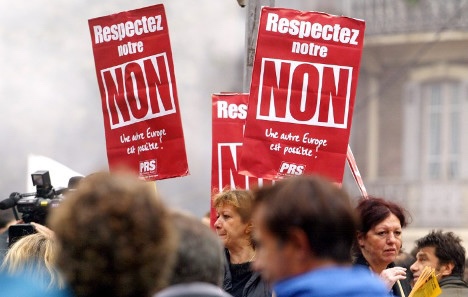
Both right and left wing critics point to the EU’s refusal to yield when it all but appeared to ignore the French and Dutch people in their votes against the new 2005 EU Constitution. Critics claim the EU simply ignored the electorate of those counties, in a show of arrogance, when it presented the Lisbon Treaty in 2007, which was generally regarded as a re-working of the defeated 2005 Constitution. The 2005 ‘no’ vote in the Netherlands had taken the EU by surprise. Eurosceptic parties had been at the political margins throughout the 1990s and early 2000s, but the 61.6% ‘No’ vote illustrated how the Dutch political elite and media were out of sync with the public. However, it is not clear that the EU, or the elites in member states, learned from the experience.

Demonstrators in France with signs which read ‘Respect our No: an other Europe is possible’ – after the electorate rejected the EU Constitution in a referendum in 2005.
Photo: AFP

The Lisbon Treaty was presented in 2007, for adoption in 2009. Only Ireland held a referendum (2008) in which it rejected the treaty first time; only to quickly have a ‘successful’ second referendum in 2009 and ensure Ireland was no longer the only country to oppose the treaty (and the only to hold a plebiscite). Interestingly a ‘lack of understanding’ about the treaty was cited as a reason for defeat in 2008 in Ireland – perhaps another sign of the European institutions being out-of-touch with the voting public?

Left and right critics also point to the EU Commission’s ‘unelected’ nature. Whilst MEPs themselves are elected and they in turn approve those appointed to the Commission, the structure appears convoluted and different to what the UK public perceives as democratic and accountable. Even three years after the Brexit referendum, there was still controversy. This time it was over the appointment of Ursula von der Leyen, as the European Commission President in 2019, when she had not even been nominated by European Parliament. This provides further ammunition and evidence for those seeking to highlight the botched processes which the voting public don’t understand or like. The argument that national sovereignty was being taken away by ‘unelected bureaucrats’ was a gross over-simplification, but it was appealing and it was always a difficult line to combat. Repeated assertions that voters had no way of removing the unelected and unaccountable commissioners only worsened the situation…

“What is the point of having a vote if the real decisionmakers are unelected, unknown, and unaccountable? Those are the questions that are at the root of the EU’s problem with the democratic deficit.”

Cato Institute

Add to all this the labyrinthine processes and inter-relationships of the multitude of institutions, then we really do have a confusing picture of what the EU is about. The lack of understanding about how the institutions work inevitably leads to a sense of detachment from it within the general populace. The European Commission, The Council of the EU, the European Council, European Parliament and the European Court of Justice and then advisory bodies such as the Committee of the Regions and the Economic and Social Committee… is it any wonder people cannot relate? The confusion allowed journalists to lazily stir up a lot of hype over things which were mere ideational dialogue. For instance, they would attribute some ‘wild and whacky’, but threatening, ideas to so-called ‘eurocrats’ and present them as things which were likely to happen – even if they were not.

Since becoming PM in a coalition government in 2010, David Cameron had staved off mounting pressure within his own party for an EU referendum. However, when UKIP amassed 4m votes in the 2015 General Election and 80+ of his own Tory backbench MPs were spooked and threatening rebellion on the green benches, then Cameron (a remainer) tried to get the EU to reform. He asked for national parliaments to have the ability to block legislation originating in Brussels. This was refused. The EU had to know at this stage that a British referendum was the likely next step. However, it gambled that the UK public would not vote to leave the EU. It’s refusal to compromise on this occasion, and on prior occasions, played a part in pushing many of the UK electorate into the Leave camp. “If the EU was this uncompromising when a Brexit vote was imminent”, Brexiteers would argue, “imagine what it will be like if and when the vote to leave is defeated?”

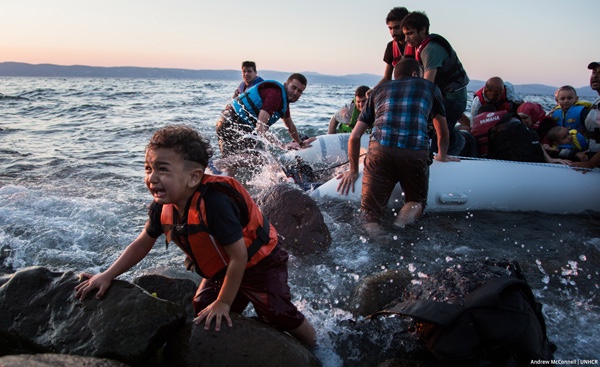
Another crucial, but unfair criticism, of the EU institutions ahead of the referendum was its handling of immigration. The Cato Institute points to Greek and Italian failures to curb immigration on their own shores and then onward across Europe. Coupled with the ‘welcoming attitude’ of Germany and Austria toward those fleeing war torn countries, such as Syria, the media was able to present the EU as suffering an “immigration crisis”. It is true that the number of asylum seekers was significant in 2015-2016, but what is the alternative to allowing the asylum of those men, women and innocent children seeking to escape a cycle of war, squalor, misery, abuse and death in refugee camps? Do you return them to danger? Do you turn them back on dangerous waters? The EU was built to overcome the worst manifestations of nationalistic sentiment and to put human beings first, wherever they may come from. This is its strength. What the media were calling an “EU migration crisis” was in fact a global humanitarian refugee crisis, not of the EU’s making, but which required a humanitarian response.

Refugees flee Syria across dangerous waters, arriving in Greece. UNHCR | Andrew McConnell

The myth advanced by Brexiteers that immigrants are a drain on public resources was another effective line of commentary which encouraged the public to vote Leave. Increasing the levels of fear to get the vote out is nothing new, but sadly, one of the unintended consequences was a predictable rise in hate crime whilst simultaneously helping the Leave campaign. A report produced for the UK Government by the Migration Advisory Committee in 2019 has completely debunked the argument that EU migrants are a drain on public resources. The document found that EU citizens have little impact on UK wages, they pay more in taxation, are not linked to increasing crime rates and they contribute “much more” to the NHS than they consume. The report contrasts this with the UK-born population who had a deficit of £41.4bn and non-EU migrants who had a deficit of £9bn, concluding that “EU immigrants… are good for the economy.”

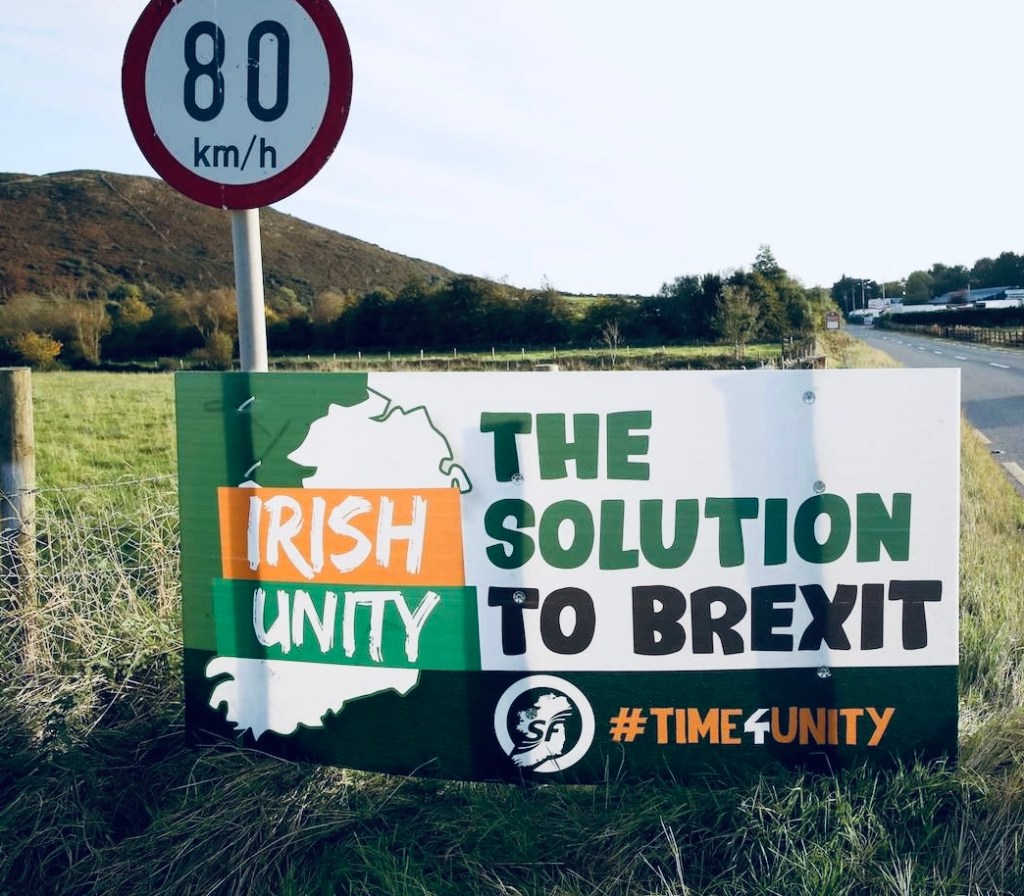
The impact of the The Brexit referendum result on Irish politics has been seismic. A slowly reforming NI, leaving ‘the troubles’ further and further behind, was fast becoming an acceptable political entity for a majority of Irish nationalists – but only whilst it was positioned within a framework of greater European integration and co-operation. The eroding importance of national identity, as economic borders and barriers between north and south tumbled and co-operation increased, engendered some sense of stability in Northern Ireland – possibly for the first time in its short history. Brexit smashed this and it has de-stabilised Northern Ireland, casting real doubt over its longer term future. This has resulted in the border question becoming more live than it has been since 1921. Unionists who supported Brexit have committed what had to be, even at the time, the most obvious act of political suicide ever. It is very difficult to discern how they failed to see it. I think the penny might be starting to drop now among all but the most tone-deaf unionists. In irony of all ironies, what might save unionists from a united Ireland, in the immediate future, is the rise of SF in the south. It isn’t a united Ireland which most soft unionists or non-aligned voters fear most – it is the spectre of a Sinn Fein controlled Irish Republic which strikes horror into the hearts of most non-republicans.

Brexit has brought the border question into sharp focus again…

In conclusion then, the European Union has not been a failure – but it has had its failings. It has been a major success in achieving its primary goal of attaining peace and stability, but its over-complex and seemingly ‘untouchable’ structure has opened it up to accusations that there is a democratic deficit. Secondly, the EU’s inability to adequately reform itself and its alleged disdain for the outcome of popular votes in Holland and France opened it up to further criticism. Thirdly, the growth in size of the EU and the influx of asylum seekers from Africa and the Middle-East created a perfect storm for nationalistic tendencies within member states to flourish – the very tendencies the united Europe project was set up to overcome.

Brexit has the potential to greatly destabilise international relations in the long term if other countries follow the UK’s individualistic and nationalistic example. It has hugely destabilised Irish politics by bringing the border question back into sharp focus, just as it was fading into the background. Even the most politically naive must realise that a border poll in Ireland, and everything a campaign would involve, would make the Brexit campaign look like a Disney movie. Ireland is not ready yet to embark upon such a polarising path which could tear civic society apart and bring to the fore the extreme binary positions – much the same as what happened with the Brexit debate.

On balance, it would have been better to continue to fight hard for reform from within the EU. It was (and is) a project with flaws, but it is a project with something at its core which is worth fighting for.

The instability created by Brexit could cast a long shadow…

Re-structuring government in Northern Ireland… a novel idea?

As the chaotic approach to dealing with the fall-out of Covid wreaks havoc, it got me thinking about our very unique governmental structures in Northern Ireland. We remain the only country in the world to use the d’hondt formula to select its executive. Add to this mandatory coalition, the Executive’s “silo mentality”, the parallel consent mechanism and abuse of tools such as the Petition of Concern, then it is hardly surprising that our Executive has singularly failed to win the hearts and minds of almost anybody in the country over the past nine months.

I have been particularly struck by the lack of direction and cohesion in the Department of Education. We had the examination results debacle and failed algorithms in the summer, before finally settling on teacher produced grades; then we have had an abject failure to plan for the 2020/21 academic year – whilst completely ignoring advice from examination bodies, school leaders and teachers on the ‘front-line’. It resulted last week in a decision by the Minister to cut AS-level and A2-level (16-19 year olds) examination content by 60%… when most schools have already completed circa 40-50% of their examinable content!

The abysmally poor leadership provided by politician after politician in the Department of Education in Northern Ireland since devolution of powers in December 1999 has me thinking that we need a sea-change in how we view our Executive and the roles of our politicians in it. I do not think that politicians should have ministerial portfolios at all. The Dept of Education should be headed by a senior educationalist and the Dept of Health by an experienced leader in medical practice, for example.

How might this work? For this I am looking to the US method of Cabinet selection. President-Elect, Joe Biden, is currently in the process of lining up his Cabinet picks… and this is very different to the process in the UK.

In the United States of America, Cabinet officers are nominated by the President, but must be confirmed by U.S. Senators. The President may select candidates from any walk of life — business, education, law, the military… or politicians. The strict separation of powers in the USA and the Ineligibility Clause of the U.S. Constitution, however, means that anyone appointed to the US Cabinet cannot sit in the legislature. Perhaps we need to be bold in NI & break from the current structures, in which we try vaingloriously to ‘doff our cap’ to the Westminster-model of politics whilst simultaneously trying to satisfy the ‘procedure-hungry’ institutional infrastructure that our divided society requires.

Allow experts to head our government departments…

Perhaps in Northern Ireland we need to appoint our Ministers from a similar pool to that of a US President? Perhaps we do need to appoint a distinguished business figure to look after our Department for the Economy, a distinguished educationalist to look after the Department of Education and a distinguished medical expert to look after the Dept for Health, for example?

We would, of course, still need a small elected executive of politicians (without portfolio) reflecting the will of the electorate and the composition of our divided society. This could be a five or six member elected executive (perhaps even smaller)? The finer details would need worked through. In any event, the political executive would have a strategic role over devising the Programme for Government and managing the budget and they could also nominate the specialist ministers/heads of government departments (from business, or education or medical practice etc) – but crucially, no individual political party would be ‘attached’ to a departmental portfolio itself, thus preventing a ‘silo’ mentality and also helping to encourage a more long-term and joined-up approach to governance.

IN the process, the scrutiny role and powers of our legislative Assembly should and could be elevated. It could play the role of approving the executive nominees. Each nominee could be put through a rigorous US-style committee hearing before going to the full assembly for a plenary vote. Hopeful nominees should expect to require something like a two-thirds or three-quarters majority for ratification… In the US the requirement is only a simple majority, but a ‘super-majority’ should help ensure the completely non-partisan, non-political nature of the appointment.

Of course, there would need to be mechanisms to call any head of department to answer to committees or to plenary sessions for accountability purposes. There should also be a mechanism for removal if necessary – which does not currently exist among our politically appointed Ministers.

Taking departmental portfolios and key decision-making out of the hands of politicians and into the hands of experienced practitioners should improve decision making. IN the modern era this is actually becoming more crucial. Political parties tend to push young and dynamic politicians into positions of power, many of whom, whilst capable, have never held down a job in any industry or profession, have very little life experience and are ‘career politicians’ whose only work experience is working on an MLA’s, MP’s or a Minister’s staff since they left university.

Removing individual ministerial portfolios from the attachment to political parties will not only allow us to shift from a silo mentality, but it will free up the elected executive ministers to look at bigger, strategic and long term issues – legacy, post-Covid recovery, dealing with Brexit, under-funding in our crumbling health service or the crisis with our water infrastructure and much more.

Having an “expert” Head of Department take decisions (and be answerable to the power-sharing Assembly) will allow non-political and tough decisions to be taken, whilst providing ‘political cover’ for our politicians to express faux-outrage about a decision. Our politicians can protest whilst being “rendered politically powerless” to over-turn the offending decision, without some sort of ‘super-majority’ support. This is much how health service reform in the early 2000s, welfare reform in 2014/2015, same-sex Marriage and abortion laws in 2019, were passed through Westminster. Our Executive had abdicated its responsibility in each of these instances. The pretence from some parties that they ‘opposed’ the changes via their dog-whistle politics did not stop the changes.

Of course my musings above would not lead to utopia nor would it even lead, necessarily, to great decision-making. However, we are not looking for utopia… we are merely looking for an improvement on the current stasis, political mismanagement and short-term political point scoring that dogs our politics at every turn…

Poverty, opportunity loss & educational under-achievement in Northern Ireland

A Northern Ireland independent public policy think tank, published a report last week on what opportunities and challenges exist to support young people in developing skills for a modern workforce. The report outlines the wider economic context that influences skills and training for the 14-19 age group. In the process it lays bare the stark poverty figures in Northern Ireland.

The report makes for sobering reading. I have attached a copy here, but in summary…

Northern Ireland has some of the lowest levels of high paid jobs and productivity of any UK region. Northern Ireland has the lowest employment and highest unemployment rates and the highest inactivity rate of all UK regions. We have the highest level of low paid jobs in the UK. Research found that 1 in 4 jobs were paid below the real living wage in 2020, equating to approximately 240,000 jobs in the economy of Northern Ireland. 70% of young people aged 18-21 are in roles that are below the real living wage. The levels of youth unemployment (11.5%), according to the report, are concerning as sectors which employ high levels of young people have been most affected by the pandemic – presumably a reference to the hospitality and leisure sectors. Prior to the outbreak of Covid-19, 10.2% of young people aged 16-24 were classed as not in Education, Employment or Training.

The think tank, Pivotal, is going to produce a report in the new year which will include a closer look at educational inequalities and disengagement amongst young people in Northern Ireland, but a few things stood out in this month’s report. Most notably, there are numerous factors relating to disengagement amongst young people in education & training. Most of these factors are related, in some way, to poverty and inequality of opportunity. For example, a family history of economic inactivity, health and wellbeing opportunities – including mental health, and housing difficulties are all listed.

The report also points out that strategies in Northern Ireland are generally based on the assumption that young people are prepared and ready to engage. This is not the case and this issue of social and educational disengagement must be considered during the design of future strategies.

I know first hand that there is a link between poverty and educational opportunities and attainment. I was in secondary school during the economic recession of the late 80s and early 90s. My dad lost his job and wasn’t to work again for four years. He was ‘too old’ and too qualified for most available jobs. When he did get a job it was in a much less skilled industry with much less pay. In fact he went from working for a construction company as the Northern Ireland Section Leader of a team of draftsmen (drawing designs for construction – similar to an architect) to working with me in an M & S warehouse!

Teenage years on free school meals were difficult, but I was lucky enough that my situation forced me to work hard to get my A-levels, whilst, like many people, holding down a part-time job. I cleaned offices for a while at 14 years old, before getting a job as a dishwasher at 16. The jobs gave me independence and meant I didn’t need to ask for anything or add to the family distress. When I successfully got into Queen’s University, I landed that M&S job which enabled me to, along with my grant, keep financially afloat and actually pay money into the family home.

The truth is, because of our financial circumstances, leaving NI and going to university across the water or across the border was simply not possible. In the end I went to university in Belfast and continued to live at home. So, I know first hand the link between poverty and opportunity. This is nothing new. Now, in the 21st century, we really must come up with innovative strategies to address the inequality of opportunity.

Educational disengagement needs to be factored in to future strategies in NI…

Prior to the welfare changes and the introduction of Universal Credit the Northern Ireland Children’s’ Commissioner reported that there were 444,000 children in Northern Ireland and that 103,400 of these children lived in poverty. This figure is suspected to be higher now owing to UC. 61% live in households with at least one parent who is working – what we would call, “the working poor”.

According to NICC, this is “is almost 1 in every 4 children in Northern Ireland living in a family which struggles to provide for their basic needs, providing a warm, adequate home, nutritious food, appropriate clothing and pay for childcare costs. Children whose parents often have to get into debt to pay to make ends meet and do not have the means to save money for unexpected costs or family outings.”

The NICCY website also tells us: “Children in poverty are twice as likely to leave school without 5 good GCSEs. They are also more likely to suffer poor mental health and have fewer years of good physical health.” Crucially, however, according to NICCY, “child poverty is not inevitable… If government create and put the right policies in place, child poverty can be eradicated.”

A focussed and innovative strategy to lift people – particularly young families and the working poor – out of poverty, is now long overdue.

Taking the knee…

More and more football supporters are complaining about the players continuing to ‘take the knee’ many months after they first started doing this. A group of Millwall supporters booed their own players for performing the peaceful gesture this weekend. However, it isn’t just Millwall fans who have turned cold on ‘taking the knee’; increasingly I am seeing my own friends sharing posts opposing the gesture on social media and making negative comments on news stories. These are not people whom I would describe as racist or bigoted either. They post things like “enough is enough” or “keep politics out of sport”. The problem is, I believe, the same difficulty we always run into with political symbolism – no two people ever read it the same way.

All political symbolism falls foul of the fact that there is never a single interpretation of a symbol that everyone shares. Political symbolism is very much the victim of a multi-faceted lens. Millwall footballer Mahlon Romeo was distraught at the fans actions. He said, “the fans who have been let in today have personally disrespected me… What they’ve done is booed and condemned a peaceful gesture which was put in place to highlight, combat and stop any discriminatory behaviour and racism. That’s it – that’s all that gesture is.”

But how do those who get so publicly aggravated by the gesture view it? Why do they get so annoyed? I think the answer lies in a mixture of a lack of willingness to understand, a need for education, a genuine belief that politics should be kept out of sport, intolerance and racism. Yes, there is no doubt that pure racism is a factor, but not a factor in all cases I believe.

I think a misunderstanding of the Black Lives Matter movement is at the root. Of course, the death of George Floyd – by choking, as a police officer put his knee on his neck for nine minutes – in Minneapolis was a spark for the recent protests and the outburst of BLM sentiment. A character assassination on Floyd did reveal that he had some serious offences to his name. This does not alter the fact that a police officer’s job is to detain unarmed offenders, not kill them. Neither does it really tell the whole story. Floyd got caught up in the criminal justice system as young as 23. The fact is, that most black youths from his estate in Texas did. Texas had one of the highest incarceration rates in the USA and several studies illustrate that Texan authorities are more likely to target black men than white. Black men were routinely rounded up by police officers and once they had one bad mark against their name it became easier to pile on more.

The BLM movement in general has become much maligned. There has been a lot of nonsense talked about BLM and it has fallen victim to people’s lack of willingness to understand its arguments. Recently it was wrongly reported that it was setting up as a political party. In fact DUP and UUP politicians in our own council chamber voted against lighting up the civic building because of these inaccurate newspaper reports – despite the very quick response (within minutes) by BLM stating that this was not true. Neither do BLM UK wish to ‘abolish’ the police as was stated in the council chamber also.

This idea to ‘de-fund’ the police is an unfortunate slogan for a more subtle idea – and it originated with BLM USA and in a very different context.

In the USA the primary goal is reallocation of resources, funding, and responsibilities being taken away from the police toward other social initiatives. According to Alex Vitale, a professor at Brooklyn College, over the last 40 years, police have been used as a solution to America’s social ills – from mental health interventions to drug addiction – mostly as result of the USA’s poor welfare system. The cost of policing in the US has tripled in that time to $115 billion. In many cities, spending on police dominates city budgets, sometimes amounting to over half!

Proponents of ‘defunding’ argue that there should be investment in areas that support people, rather than arrest them. So, to help victims of domestic violence there should be more investment in women’s centres specialising in trauma. Police could also be removed from the process of sectioning the mentally ill. More investment could also be made in education and youth centres and even in educating police officers on how to effectively deal with someone accused of using a counterfeit $20 note – such as Floyd. Whatever way you look at it, ‘defunding the police’ is probably an unnecessarily antagonistic slogan for something which is actually more nuanced.

The systemic discrimination against black people is not in dispute. The African slave trade and slavery lasted for centuries and it leaves a legacy for families today. The century after the abolition of slavery in the USA was a brutal one for African Americans. Segregation, no voting rights, all-white governmental and judicial systems meant that the end of slavery did not mean the end of suffering.

The brutal murder of 14 year-old Emmett Till in Money, Mississippi was a potent symbol of the powerlessness of African Americans in 1955. Two men beat him nearly to death, gouged out his eye, shot him in the head and then threw his body, tied to a large fan with barbed wire, into the river. An all-white jury set both men free at a time when no single white man had ever been convicted of killing a black man in the south in the USA.

African Americans had to fight for every advancement they made. Even after the Supreme Court declared the desegregation of schools in 1954, black schoolchildren would need to be escorted to schools. The Little Rock Nine and Ruby Bridges spring to mind. Little, six year old, Ruby, was escorted by armed guard to school every day in 1960. She walked past crowds screaming vicious racist slurs at her. She spent her first day in the principal’s office owing to angry white parents removing their children from school in protest. Only one teacher, Barbara Henry, was willing to accept Ruby, and all year, she was a class of one. Ruby ate lunch alone and sometimes played with her teacher at recess, but she never missed a day of school that year. Ruby’s family suffered severely. Her dad lost his job and the stores refused to serve her family and her grandparents were evicted from the farm where they had lived for decades.

If people think that systemic abuse and racism is a thing of the past they are wrong. Yes, things are better… but if you think that better than slavery, segregation, social ostracism, disenfranchisement and extreme violence is ‘enough’ then you really should try to listen more to those like Mahlon Romeo. You should watch Enslaved with Samuel L Jackson. You really must watch 13th, which is currently on Netflix. You should also watch the Kalief Browder Story, which can also be found on Netflix.

If you think that racism only exists in the USA and not the UK, then listen to the countless black footballers and others who tell you this is not the case. Listen to really learn and understand. I would recommend you also read, Michael Fuller’s book, A Search for Belonging: A story about race, identity, belonging and displacement.

If you don’t know; if you don’t understand, then please don’t criticise those taking the knee. If you don’t want to learn that is fine also – people lead busy lives; but please refrain from unsolicited and ill-informed comment.

Finally, if whilst sitting in your armchair, stuffing your face in front of the fire, you find it an aggravation seeing players taking the knee; if that irks you and makes you angry enough to go to war (on your keyboard), if you cannot even tolerate that… then it should make you wonder: Could you have been one of the parents taking your child out of school because you couldn’t tolerate a black child attending? Could you have been one of the teachers who refused to have a black child in the class? Perhaps you might have been the store owner refusing to serve the family or the boss refusing to employ the upstart of a father? Could you have been one of the jurors in the Emmet Till trial?

Enough is enough right?

Sure, they had schools of their own…why the hell did they want to attend white people’s schools? The vote? They’ll be wanting to rule the country next won’t they?Emmet Till? Surely he should have known his place in the south and respected our traditions – and shouldn’t have spoken to a married white women in a playful tone, or any tone for that matter? Who would you have been in the days of slavery, when those ‘bleeding heart’ liberals wanted to free the slaves?

Taking the knee? So disrespectful, right? They’ve made their point already haven’t they?

Well maybe they have? Maybe they feel they haven’t? Either way if you can’t endure a few months of watching footballers take the knee, imagine what black people had to endure for centuries before you start crying your woes…