By Julian McGrath
Finalist – NILGA 2025 Local Government Awards, Best Initiative by a Councillor
Northern Ireland’s local councils are demonstrating that even without sweeping legislative powers, they can lead the way in tackling poverty—through partnership, coordination, and strategic focus.
The need could not be clearer. Both the Northern Ireland Audit Office (NIAO) and the Public Accounts Committee (PAC) have issued damning reports on the Executive’s failure to reduce child poverty. They highlighted a lack of measurable targets, poor interdepartmental coordination, and no ring-fenced budget. The PAC described Stormont’s approach as a “catalogue of failures.” Despite these findings, no new anti-poverty strategy has been produced.
In this context, councils are stepping up—not because they are required to, but because they can, and because they should.
Local Action with Real Impact
In January 2024, Antrim and Newtownabbey Borough Council passed my motion to establish an Anti-Poverty Steering Group. The group brings together elected members from across political parties, senior officers, and community partners to develop and drive forward a borough-wide anti-poverty strategy.
The group’s work is focused on mapping existing services, identifying duplication, strengthening interdepartmental communication, and ensuring better alignment between the council and those delivering vital support on the ground.
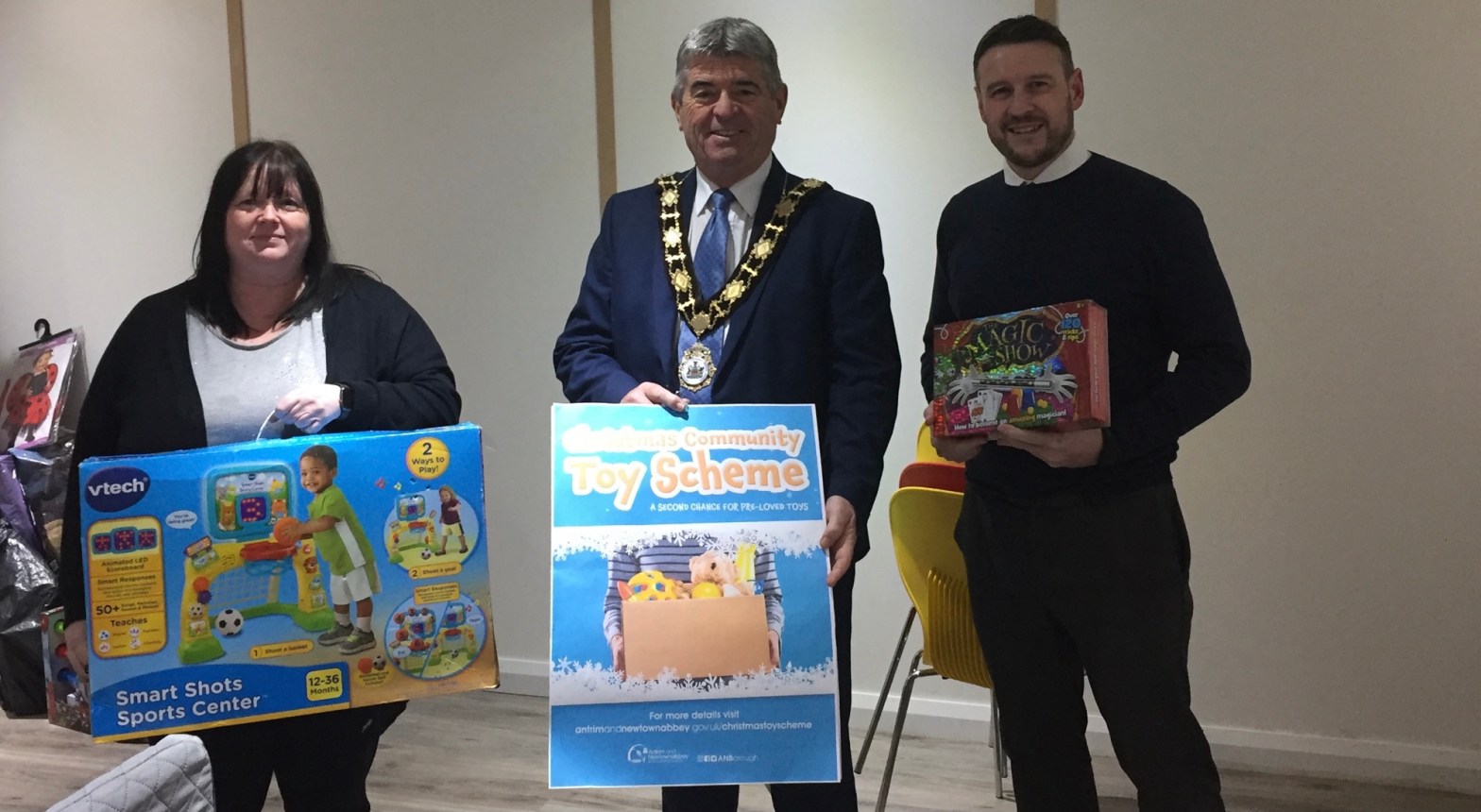
Some excellent local services already exist—such as the borough-wide school uniform support scheme and the Christmas toy initiative—and will be incorporated into the strategy. These initiatives are just part of the broader network of support the council has helped build over recent years. The challenge now is to connect, coordinate and expand that work into a more strategic framework.
What Councils Can Do
While councils in Northern Ireland do not control education, housing, or welfare policy, they do hold important powers in economic development, community planning, sustainability, and local regeneration. These levers, when applied cohesively and strategically, can have a direct and lasting impact on the structural causes of poverty.
Key to this approach is recognising that every department has a role to play. In Antrim and Newtownabbey, for example, sustainability officers, economic development teams, and community planners are all contributing to the strategy—reflecting a growing understanding that poverty is not someone else’s problem. It is a shared civic challenge.
A Local Movement Across Northern Ireland
Councils across Northern Ireland are moving in the same direction. Fermanagh and Omagh District Council’s Pathways out of Poverty strategy, developed in partnership with health trusts, community organisations, and local people, shows what can be achieved through cross-sector collaboration.
There is growing recognition that poverty cannot be addressed in isolation. It cuts across housing, health, education, and the economy—and so must our responses. Councils, with their close ties to local communities and ability to convene partners, are uniquely placed to lead this work.
Leadership Where It’s Needed
The PAC and Audit Office reports are clear: the lack of leadership from Stormont has left significant gaps in policy and provision. But they also point to local councils as key agents of delivery.
Councils may not hold all the powers, but they hold knowledge, trust, and relationships. They can map services, bring agencies together, reduce duplication, and coordinate responses. That kind of leadership—grounded in place and shaped by need—is not just useful. It is essential.
What is needed now is formal recognition of local government’s role. Councils should not be seen as emergency backstops but as full partners in designing and delivering anti-poverty solutions.
Across Northern Ireland, councils are showing what’s possible. With strategic focus, collaboration, and a commitment to act, local government is not simply managing poverty—it is working to reduce it.
 MultifacetedLens